
Rotobrush Air Duct Cleaning in Richmond: A Homeowner’s Guide
A Rotobrush machine running in your duct system looks impressive from the outside. A spinning brush head, a big vacuum hose, a technician in gloves. But the brush RPM, the vacuum CFM, and the dwell time per linear foot are what separate a real clean from a camera pass with spinning bristles. If you’re hiring air duct cleaning in Richmond and want to know whether the equipment is being used correctly, this guide explains what the Rotobrush system actually does mechanically, where it excels, and what questions expose a sloppy operator.
How Does a Rotobrush System Actually Clean Ducts?
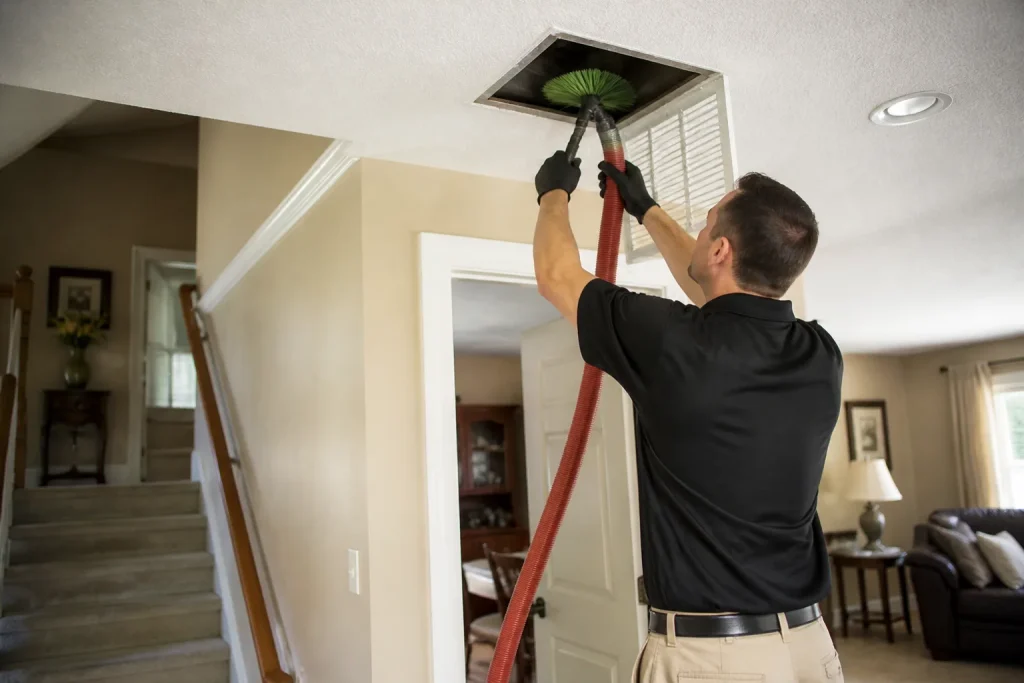
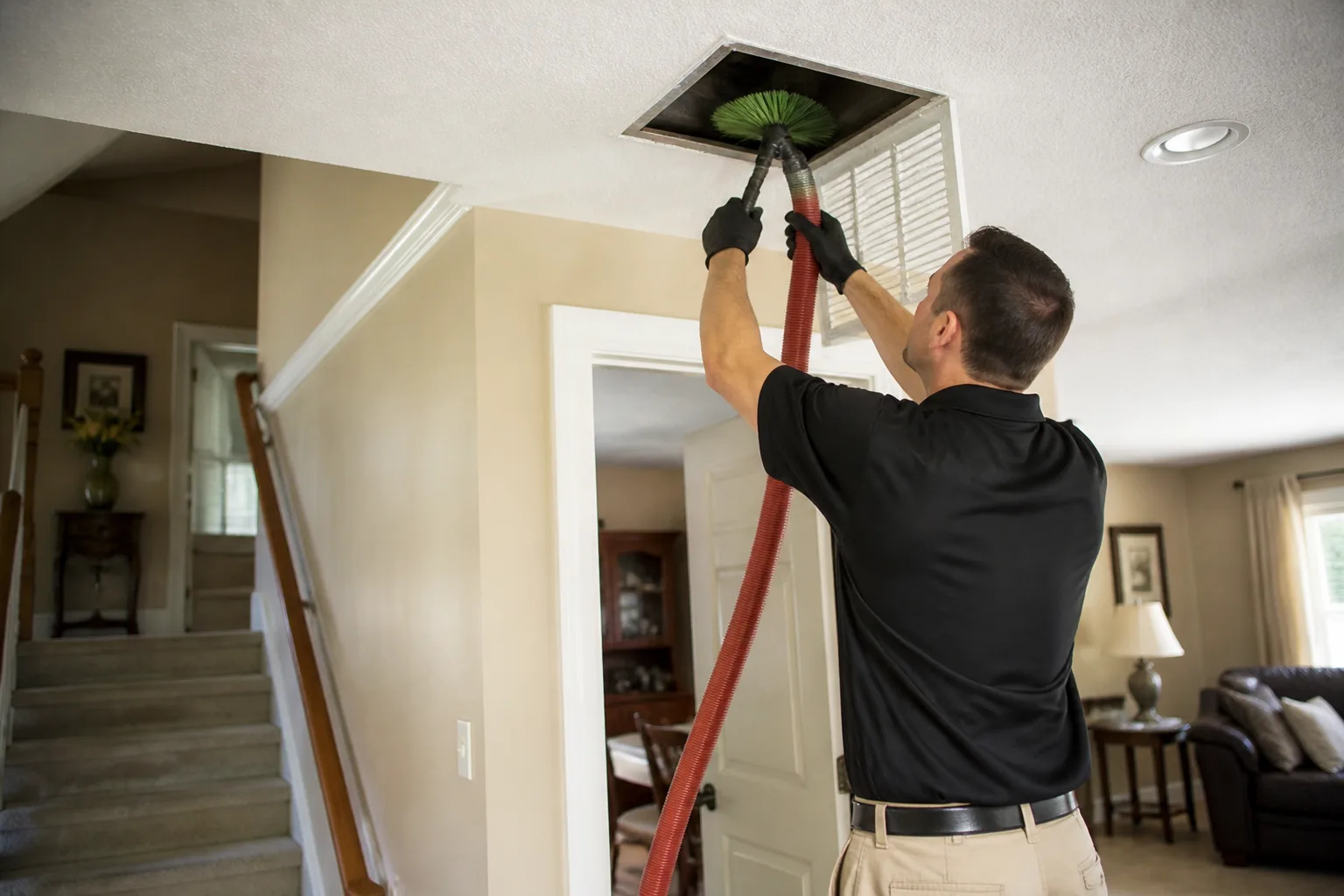
A Rotobrush is a contact-vacuum system. That means the cleaning head agitates the duct surface while vacuum pulls debris away at the exact point of contact. The brush loosens what’s stuck to the walls, and the vacuum captures it in the same motion, rather than blowing dust downstream to settle somewhere else. The system feeds a flexible rotating brush through the duct from a register opening, and the technician advances it segment by segment until the run is covered.
Why does this matter? Standard portable vacuum-only setups rely on negative pressure alone to pull debris loose. That works on smooth, rigid metal duct when the vacuum is strong enough. But the brush is what breaks the bond between debris and the duct wall. On surfaces that hold material, the mechanical agitation is doing real work that suction can’t replicate.
Three mechanical factors determine whether the job is real:
- Brush RPM and head size – the head must match the duct diameter. A brush too small for the run skips the corners. Too large, and it won’t negotiate the bends.
- Vacuum CFM at the head – agitation without strong capture at the contact point just relocates debris. Both have to work together.
- Dwell time per linear foot – how long the head stays in each section. A technician who sprints the brush through a run in fifteen seconds is not cleaning it.
If you watch a technician and the brush is flying through runs faster than seems reasonable, that’s worth asking about. A professional Rutherford Air Duct Cleaning job takes time in each segment because the work is in the detail, not the speed.
Why Richmond’s Flex Duct Makes Contact Cleaning Matter
Richmond’s residential construction stock tells an important story. A significant portion of homes built after the early 1980s used flexible duct in at least part of the HVAC system, particularly on runs feeding bedrooms, bonus rooms, and additions. Flex duct is corrugated. It has ridges and valleys that catch debris in a way smooth metal never does. The interior is also often lined with fiberglass, which can trap and hold particles against the surface.
Here’s the practical consequence: on corrugated flex duct, vacuum-only cleaning is weak. The ridges hold material against suction, and pulling harder doesn’t necessarily break the bond. A contact brush agitates those valleys and lifts what’s lodged there. That’s the specific reason Rotobrush systems are relevant to a Richmond home with mixed duct construction. A single home in Church Hill might have original rigid duct in the main trunk and flex running to three additions, and the cleaning approach has to handle both.
This is also where a lot of bad cleaning in Richmond goes wrong. A company with a shop-vac-based setup, or a portable negative-pressure machine without a contact head, can visually clean a rigid trunk and still leave a flex run untouched because the equipment couldn’t reach the corrugations. If your ducts are flex, ask specifically how the technician handles corrugated runs.
Where Rotobrush Excels, and Where Negative Pressure Wins
No single system is best for every duct configuration. Rotobrush is strong for a specific set of jobs. Truck-mounted and portable negative-pressure systems, such as Abatement Technologies filtration setups, have their own advantages. Here’s how they compare:
- Rotobrush advantage – flex duct debris, fiberglass liner contamination, and short-run residential systems where the contact approach handles both the agitation and the capture locally.
- Negative pressure advantage – large-diameter rigid trunk lines, long straight runs, and whole-system containment where the whole house is put under vacuum so air moves toward the collection point throughout the run.
- Often the right answer – both. A thorough job on a Richmond home with mixed duct may use contact cleaning for flex branches and negative pressure for the main trunk collection.
A company that only has one tool tends to tell you that tool is all you need. A specialist knows which system fits which section. We work with Rotobrush and Nikro contact equipment, Abatement Technologies filtration for containment and HEPA capture, and we size the approach to the duct type in front of us. Familiarity with Honeywell and Aprilaire air systems also means the whole-home air quality side isn’t overlooked while the ducts are being cleaned.
Questions That Reveal Whether a Technician Is Using Rotobrush Properly
You don’t need to become a duct cleaning expert to vet a provider. You just need to ask five specific questions that separate operators who understand their equipment from operators who bought it and never learned to use it. The answers should be specific. Vague answers are a signal.
- What brush head size do you use for this duct diameter? – a competent technician matches the head to the run, not one brush for every job.
- How do you confirm the vacuum is pulling at the head? – they should describe checking vacuum pressure at the contact point, not just at the machine.
- How long do you spend per linear foot? – there should be an honest answer that reflects a real method, segment by segment.
- How do you handle flex duct runs vs. rigid trunk? – if the answer is “the same way,” that’s a red flag. Corrugated flex needs a contact and feed rate matched to the profile.
- What documentation do you provide? – before-and-after photos of the interior of the duct, not just a photo of the machine.
Good operators welcome these questions. In our experience, technicians who have spent years learning the equipment (ours have up to 9 years) are usually happy to talk about brush selection and capture. The ones who bristle at the questions are often the ones who haven’t thought about them.
What “Before and After” Documentation Should Actually Show
Documentation is where the misinformation runs deepest. A photo of a clean-looking register is worthless. A photo of the exterior of a machine proves nothing. The useful evidence is the interior of the duct: identical views taken before the brush enters a run and after it exits, showing the walls, the corrugations, and the lining.
Why do some companies avoid showing these? Because a proper contact-vacuum job leaves a visible difference on flex and fiberglass-lined duct. An inadequate pass doesn’t. A company that shows interior before-and-after images is usually confident in what the camera finds. A company that shows only a coupon, a hose running into a vent, and a satisfied-looking technician is telling you nothing about the result.
Ask for interior photos of the ducts that were actually cleaned. If your home has flex runs, ask specifically for images of the flex. If the answer is a slide show of a clean duct from a job years ago and a promise that yours will look the same, ask for fresh images. A clean duct is a specific, documented outcome, not a claim.
When to Call a Pro
Some situations are clearly a job for a trained technician with the right equipment. Others can be handled with a careful checklist. The line is usually clear once you know what to look for:
- Visible dust streaming from registers when the system kicks on
- A smell in the house that follows the HVAC on/off cycle
- Recent renovation, drywall work, or pest activity in the duct path
- Allergy flare-ups that improve when the system is off
- A dryer that takes far longer than usual to dry a load, which usually points to a blocked dryer vent cleaning need and a real fire risk
- Loose, disconnected, or crushed sections of duct that need repair rather than cleaning
For a single register hidden by furniture, a homeowner can wipe it down. For the duct run itself, the interior of flex duct, or anything beyond the register boot, the right equipment and training matter. Call a specialist when the work moves past surface dust. Duct repair is a separate, related job: a crushed or disconnected flex run won’t get fixed by cleaning alone, and cleaning a compromised run is temporary if the duct isn’t sealed and reconnected. Richmond homes with older HVAC retrofits are a common place we see this. If your ducts need both cleaning and repair, that’s a call for a provider who does both. For anything in the dryer vent or air duct path that involves disconnection or resealing, do not attempt it yourself. Call (855) 606-6205 and we’ll walk you through what your system likely needs.
Related services in Richmond: air duct cleaning, dryer vent cleaning, and air duct repair.
The Bottom Line
Rotobrush is a legitimately capable system in the right hands. The contact-vacuum design excels at flexible duct and fiberglass-lined runs, which a large share of Richmond homes have. It is not magic, and it is not universal: negative pressure and containment systems still do specific jobs better, and often the right answer is using both. The things that separate a real clean from a sales pitch are unglamorous. Brush head sized to the duct. Vacuum confirmed at the contact point. Honest dwell time per linear foot. A segment-by-segment method. Interior before-and-after photos a customer can actually inspect. Ask those questions and the answers will tell you what you need to know.
If you’re in Richmond and want a straight answer about your ducts, Rutherford Air Duct Cleaning offers free estimates. Call (855) 606-6205. We answer 24/7. Fast dispatch from 7am to 7pm, Sunday through Friday. We work with Rotobrush, Nikro, and Abatement Technologies equipment, serve homes with mixed duct construction throughout Richmond, and provide both duct repair and Guardsman-grade cleaning to a documented standard. Photographs of your own ducts, before and after, come standard.
Frequently Asked Questions
For flex duct and fiberglass-lined duct, yes: the contact brush agitates corrugations that suction alone can’t lift. For large rigid trunk lines, a negative-pressure system often does better. The right answer depends on what kind of duct you have, which is why a provider who carries only one system may not be able to serve your whole home.
Ask for interior before-and-after photographs of your own duct runs, not a stock image or a photo of the register. A technician using the equipment properly has no reason to hide the result. If the images don’t look different, or you’re shown the same generic photos every company shows, ask for re-inspection. Call (855) 606-6205 for a free estimate and we’ll explain what documentation you should receive.
There’s no single universal schedule. A home with flex duct and pets, recent renovation, or a family member with allergies usually benefits from more frequent cleaning than a newer home with rigid duct and no trigger events. A visual inspection is the honest starting point. Ask a provider to inspect and tell you what the ducts actually look like before quoting a schedule.
A thorough job covers every accessible run, but “every accessible run” is the honest phrasing. Some sections may be boxed in, inaccessible, or disconnected, and a good technician identifies those clearly and explains what they can and can’t reach. Contact-vacuum systems are particularly effective on branch runs, which are often the inaccessible ones in homes with additions or retrofits. If a provider claims every inch of your ductwork is reachable without inspecting it first, ask how they know.
Written by the team at Rutherford Air Duct Cleaning.
Need Air Duct Cleaning Help?
Call Rutherford Air Duct Cleaning - licensed & insured, with free written estimates in Richmond.
(855) 606-6205